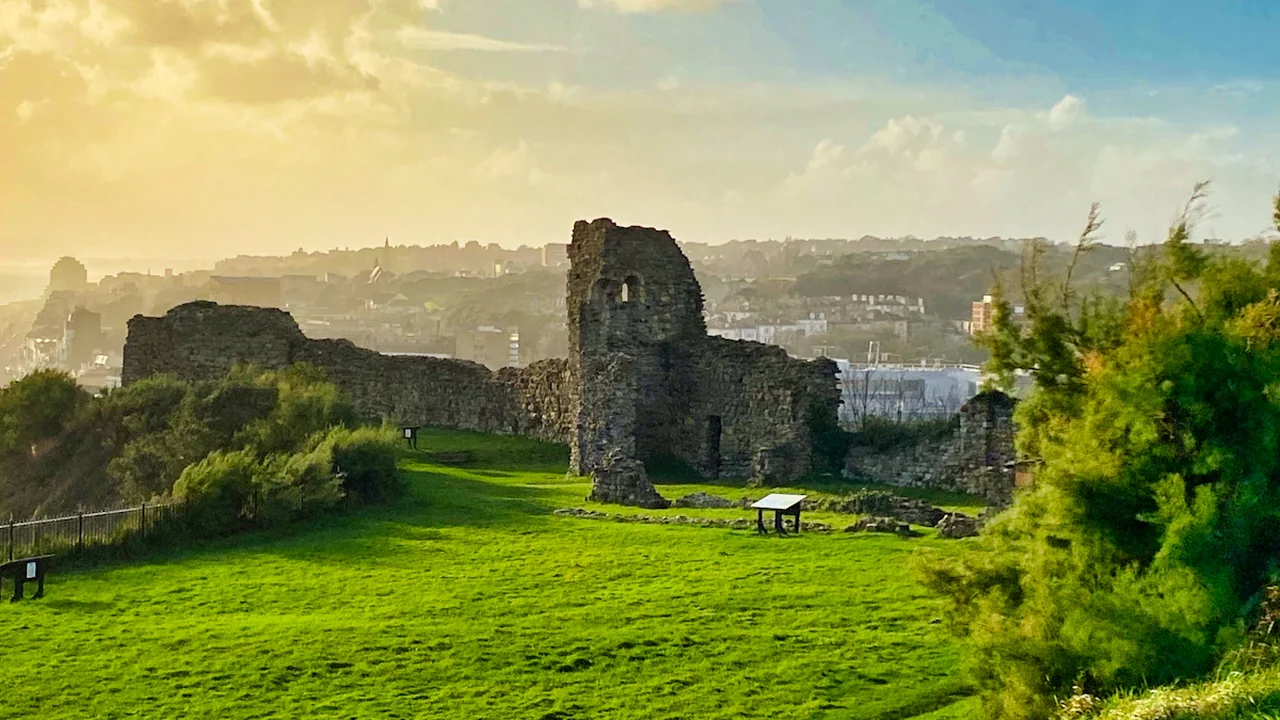
The Battle of Hastings was fought on 14 October 1066 near present-day Battle in East Sussex. William, Duke of Normandy, defeated the English army led by King Harold II. The anniversary connects that decisive event with a place shaped both by the fighting and by later acts of remembrance: the battlefield and the remains of Battle Abbey. Visitors can see the landscape associated with the battle alongside the abbey that gave it a lasting commemorative setting.
14 October 1066: the armies meet near Battle
The name “Battle of Hastings” can mislead visitors about the location. English Heritage identifies the battlefield at Battle, in East Sussex, near the modern town of that name. The fighting did not take place in Hastings itself, so the present-day site offers a more direct connection to the place associated with the encounter.
William’s Norman forces faced an English army led by Harold II. William’s victory helped bring about the Norman Conquest, changing who ruled England and shaping the country’s political and cultural history. The date remains a useful point of orientation: each 14 October marks the anniversary of the battle, while the landscape at Battle anchors the event to a specific place.
Why the battle changed England
The battle settled the immediate contest between William and Harold, but its importance reaches beyond the outcome of a single day. William’s victory helped establish Norman rule in England. The conquest brought a new ruling elite and left a lasting mark on institutions, landholding and culture.
That broad historical significance is clearer than every detail of how the fighting unfolded. Medieval accounts and images provide evidence, but they do not amount to a modern, minute-by-minute record. Historians interpret those sources alongside other evidence, and some details remain uncertain. For visitors, this distinction helps separate the well-established result and its consequences from precise reconstructions that the available record cannot firmly settle.
What the Bayeux Tapestry can—and cannot—show
The Bayeux Tapestry is a major medieval source for the Norman Conquest and the events surrounding the battle. Its scenes offer a vivid narrative, but it was made after the events and presents them through a particular visual account. It should not be treated as a neutral eyewitness record.

The tapestry can help historians understand how the conquest was represented and remembered. It cannot, by itself, settle every disputed detail or be read as a literal, camera-like depiction. Reading it with care does not diminish its value; it clarifies what kind of evidence it offers. The broad outcome is clear, while individual moments and sequences require cautious interpretation.
Battle Abbey made the landscape a memorial
The site’s story continued after 1066. Battle Abbey, later built at the battlefield, gave the place a commemorative role as well as a historical one. The abbey connected the landscape to the memory of William’s victory and made the site a lasting marker of the conquest.
This creates two layers for visitors to encounter. The battlefield is associated with the conflict itself; the abbey remains show how the location was later marked and remembered. Seeing both together makes the anniversary more than a date in a history book: it links the event to the landscape and to the subsequent act of commemoration.
What visitors can see at Battle today
English Heritage describes Battle Abbey and battlefield in East Sussex as the site of the Battle of Hastings. Visitors can encounter the landscape associated with the fighting and the remains of the later abbey. Together, these provide a place-based way to understand both the battle’s setting and how its memory became part of the site.
The source establishes the site and its historical significance, but does not provide current opening times, access arrangements or visitor facilities. Those practical details can change, so check English Heritage’s current page before travelling. The next recurring milestone is 14 October, the battle’s anniversary, when the date again directs attention to the landscape and abbey at Battle.
Source: English Heritage
Context & actions About this article
Source check Historical context
English Heritage identifies Battle Abbey and battlefield in East Sussex as the site associated with the 1066 battle.
- The battle took place on 14 October 1066
- The site is near present-day Battle in East Sussex
- Battle Abbey was built later as a commemorative site
- Source
- English Heritage
- Scope
- Battle, East Sussex, England
- Updated
- 2026-10-13 09:29
Source check
Report a trust issue
Send a clear signal to community moderation if the source, facts or context need review.




Comments