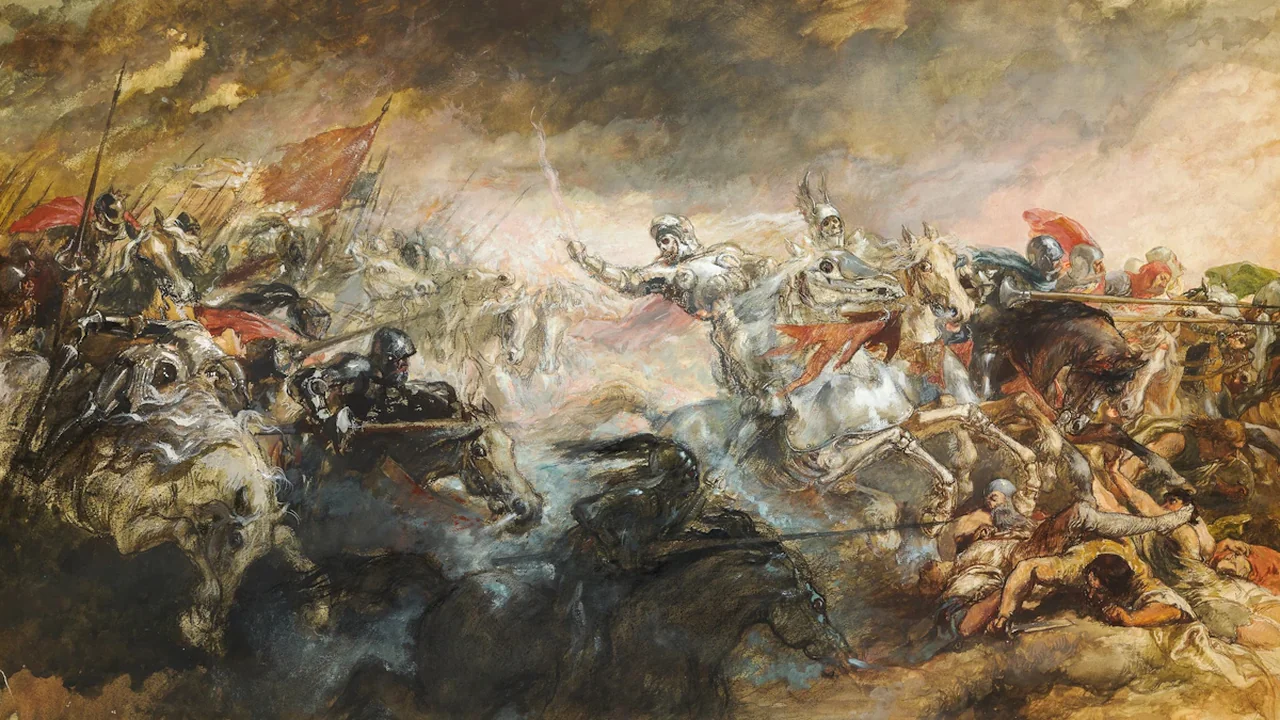
The Battle of Hastings was fought on 14 October 1066 near Hastings, in what is now East Sussex. William, Duke of Normandy, defeated King Harold II, opening the way for a change in England’s rulers. The battle was a turning point, but Norman rule took shape through further fighting and political decisions in the months that followed.
Before Hastings, two men claimed England’s throne
The succession dispute followed the death of King Edward the Confessor in January 1066. Harold Godwinson, a powerful English earl, was chosen and crowned king. William of Normandy also claimed the throne, arguing that Edward had promised it to him and that Harold had sworn to support his claim. The details and significance of those claims remain matters historians assess through medieval accounts and later evidence.
Harold faced another challenger before William arrived. In September, Harald Hardrada of Norway invaded northern England with support from Harold’s estranged brother, Tostig. Harold’s forces defeated them at the Battle of Stamford Bridge on 25 September. The victory was costly and came shortly before William’s army landed in southern England.
That sequence helps explain the pressure on Harold’s forces. After marching north to meet the Norwegian invasion, Harold had to move south again to confront the Normans. The timing and the demands of campaigning shaped the setting for Hastings, though they do not by themselves settle why either army won.
14 October: the armies meet near Hastings
William’s forces met Harold’s army near Hastings on 14 October. Harold’s men are commonly described as forming a shield wall on high ground, while Norman forces included infantry, archers and cavalry. The battle lasted for much of the day. The broad outcome is clear: William won, and Harold was killed. Some details of the fighting, including the precise sequence of events and how Harold died, are less certain.
The Bayeux Tapestry is among the best-known sources for the campaign and the battle. Its embroidered scenes show Harold’s journey, the Norman invasion and combat, but it is a visual narrative made after the events, not a neutral eyewitness transcript. Its images need to be considered alongside written accounts and archaeological evidence, with care about what they can and cannot establish.
Hastings began a conquest that continued afterward
William’s victory did not instantly give him uncontested control of England. He advanced toward London, where resistance and political maneuvering continued. In December 1066, he was crowned king at Westminster. His coronation marked a major step in securing power, but opposition persisted in parts of the country.
Over the following years, the Normans used military campaigns, new political arrangements and the redistribution of land to strengthen their rule. The conquest therefore describes a process as well as a battle: Hastings changed the balance of power, while later events made Norman authority more durable.
This distinction matters when describing the anniversary. The battle decided the immediate contest between Harold and William’s forces, but the creation of a new ruling order required more than a single battlefield victory.
What historians can establish—and what remains debated
Historians compare different kinds of evidence rather than relying on one account. The Bayeux Tapestry offers a detailed sequence of scenes and names, while medieval chronicles provide written narratives shaped by their authors’ perspectives and the political circumstances in which they were composed. Archaeology can add evidence about places and material remains, though it does not answer every question about the battle.
Some central points are well established: the battle took place on 14 October 1066, William defeated Harold, and the Norman victory led to a change of ruler. Other questions require more caution, including precise troop numbers, the exact course of particular attacks and the circumstances of Harold’s death. A source may preserve valuable evidence without making every detail certain.
The date to watch next in the 1066 sequence is 25 December, when William was crowned at Westminster. It marks the next major step after Hastings in the transfer of England’s crown, while the resistance and consolidation that followed show why the conquest did not end with the battle.
Source: English Heritage, Battle Abbey
Context & actions About this article
Source check Historical context
The date and outcome are established, while accounts and images of the battle leave some details open to interpretation.
- Compare the Bayeux Tapestry with medieval written accounts.
- Treat exact battle sequences and Harold’s death cautiously.
- Distinguish the 14 October battle from the longer conquest.
- Source
- English Heritage, Battle Abbey
- Scope
- East Sussex, England
- Updated
- 2026-10-10 08:03
Source check
Report a trust issue
Send a clear signal to community moderation if the source, facts or context need review.




Comments