Before an autumn drive, estimate fuel spending from your actual route, your car’s fuel economy and current forecourt prices near you. There is no single national price that can tell you what your journey will cost: prices vary by station and can change over time.
Calculate how much fuel your route may use
Start with the distance you expect to drive and the fuel economy your vehicle achieves. If your car’s efficiency is shown in miles per gallon (mpg), convert the route distance into estimated litres using this formula:
Fuel needed (litres) = distance (miles) ÷ mpg × 4.546
Then multiply the estimated litres by the price per litre:
Fuel cost = fuel needed (litres) × price per litre
For example, for a route of 200 miles in a car averaging 40 mpg, the calculation is 200 ÷ 40 × 4.546, or about 22.7 litres. To turn that into a cost, multiply 22.7 by the price per litre shown at the station you are considering. This is a formula illustration, not a current UK price or a prediction of what a particular car will use.
If your vehicle displays fuel economy in miles per litre, use distance ÷ miles per litre to estimate litres. Check that the vehicle figure and route distance use the same units. A round trip should include the return distance unless you plan to refuel en route.
Compare nearby forecourts using current prices
Look up prices for petrol or diesel at stations near your starting point and along the route. Compare like with like: petrol prices against petrol prices, and diesel against diesel. Check when a price was recorded if that information is available, since a listing may no longer reflect the pump price when you arrive.
The Competition and Markets Authority (CMA) publishes road fuel price transparency information and monitoring material for the UK petrol and diesel markets. Its material provides context on the market and its data; it does not replace checking the specific forecourts you might use for a particular journey.
Before setting off, compare a small number of realistic options:
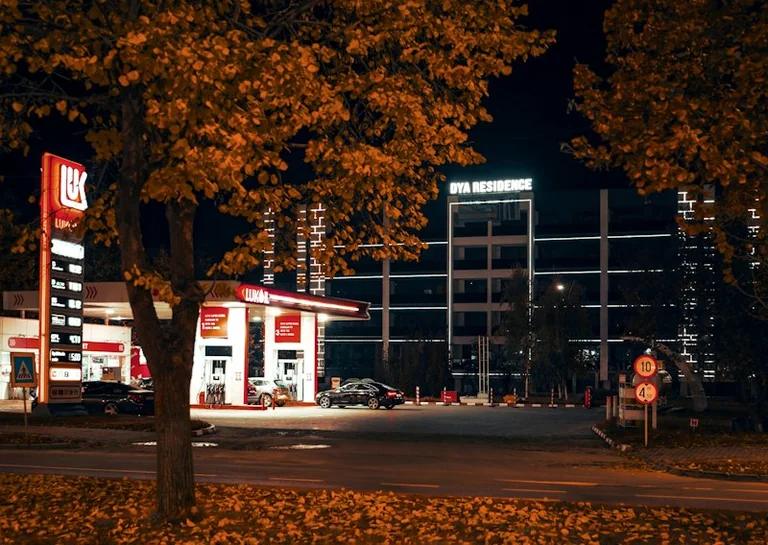
- A station near home, especially if you need to fill up before leaving.
- Forecourts close to your route, where a stop adds little distance.
- A station near your destination if you expect to need fuel there.
Use the same fuel price in your calculation as the fuel your vehicle requires. If you compare prices from separate listings, check the location and timing rather than assuming each one is current or directly comparable.
Include the detour in the total journey cost
The lowest listed price may not produce the lowest overall trip cost. A station off your route adds miles, which use fuel, and can take extra time. Compare the saving on the litres you expect to buy with the fuel needed to reach the station and return to your route.
A useful comparison is:
- Estimate the journey’s fuel cost at a convenient station.
- Estimate the extra distance to a cheaper alternative.
- Add the fuel cost of that detour to the alternative’s likely refuelling cost.
- Compare the totals, allowing for how much fuel you will actually buy.
If the detour is long or the price difference is small, the convenient station may work out better overall. If you would make the stop anyway, the extra distance may be negligible. Your route, fuel level and planned amount of fuel all affect the comparison.
Allow for real-world variation
A calculation is an estimate, not a guaranteed bill. The vehicle’s displayed or published fuel economy may differ from its consumption on a particular trip. Traffic, speed, hills, weather, vehicle load, tyre condition and repeated short journeys can all affect fuel use. Autumn conditions and a heavily loaded car may also mean your journey differs from the figure you use for planning.
Route planners can also give different distances depending on the chosen roads and stops. Use the route you expect to drive, and include any planned diversions. If your car reports recent average fuel economy for similar driving, that may be a more useful starting point than a general figure, though actual consumption can still change.
Make a practical check before you leave
Check local prices close to your departure, confirm the fuel type and station location, and recalculate with your planned route. For a longer drive, identify a second convenient refuelling option in case traffic or a change of plans affects where you stop.
The CMA’s road fuel transparency collection is useful for understanding its monitoring and the scope of published information. For the cost of your own journey, the decisive inputs remain your route, your vehicle’s real-world fuel economy and the current price at a forecourt you can reasonably reach.
Source: Competition and Markets Authority
Context & actions About this article
Source check How the estimate works
The cost calculation uses your route distance, vehicle fuel economy and a current local price per litre; real fuel use can vary.
- Use the route distance you expect to drive.
- Match the calculation to your vehicle’s fuel economy units.
- Check the station’s fuel type, location and listed price timing.
- Source
- Competition and Markets Authority
- Scope
- United Kingdom
- Updated
- 2026-10-28 10:42
Source check
Report a trust issue
Send a clear signal to community moderation if the source, facts or context need review.


Comments