By AtheneNet editors
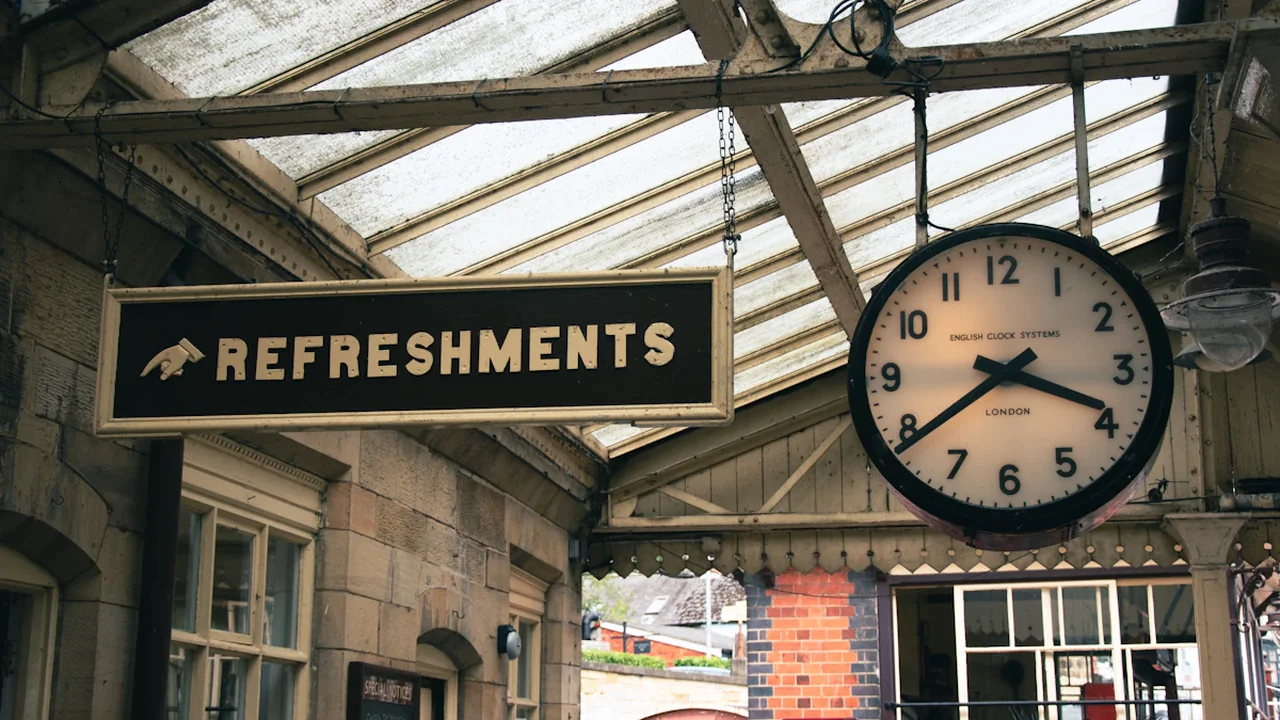
Catching a train depends on a simple agreement: the time on your clock must mean the same thing as the time in the timetable. Britain’s railways helped make that agreement possible by adopting Greenwich Mean Time, replacing competing local times with a shared reference. The history also explains a distinction that still matters when reading a timetable today: standard time and seasonal clock changes are separate arrangements.
Greenwich, in southeast London, became central to this everyday convention. According to Royal Museums Greenwich, most railway companies had adopted GMT by the 1840s. Their practical need to coordinate journeys helped turn an observatory’s time reference into something useful far beyond astronomy.
Why different towns could keep different times
Before a shared time standard, local time was tied to the Sun’s position. Because the Earth rotates, the Sun reaches its highest position at different moments in places with different longitudes. A town farther west could therefore keep a slightly different time from a town farther east without either clock being defective.
That distinction was manageable when daily activities mostly took place within one community. A local clock could organise work, appointments and opening hours without needing to agree precisely with a clock in a distant town. The difficulty emerged when people needed to coordinate activities across those places.
Railway travel made the problem especially concrete. A timetable connects departure times, arrival times and onward journeys. If each stop interprets those numbers through its own local clock, a passenger needs more than the printed time: they also need to know which place’s time the railway means.
Consider an illustrative journey between two towns whose clocks differ by several minutes. A departure listed at noon becomes ambiguous unless the passenger knows the reference being used. The problem is the mismatch between otherwise functioning clocks, rather than an inability to measure time accurately.
Royal Museums Greenwich describes these differences between local times as part of the pressure that drove the creation of standard time based on the Greenwich meridian. The familiar act of checking a departure board rests on the solution to that problem.
Railways needed one meaning for every departure time
Railway companies adopted Greenwich Mean Time to overcome the differences between local times. A common reference meant a timetable could use one consistent system across a route, instead of requiring travellers to translate between the clocks of successive towns.
The change made coordination easier to understand. A scheduled departure and a scheduled arrival belonged to the same time scale. Passengers could compare connections, while railway operations could be organised around a common clock. The timetable became more useful because its numbers had an agreed meaning.
The chronology matters here. Royal Museums Greenwich says that most railway companies used GMT by the 1840s. That describes broad adoption across the railway industry; it does not mean every clock throughout Britain changed on one particular day.
A railway choosing a time standard and a community changing its daily habits are related developments, but they are not identical. The strongest point supported by this history is that railways created a pressing, practical reason for different places to agree on time.

Greenwich Mean Time supplied that agreement. “Mean” refers to an averaged measure of solar time, rather than the changing reading of the apparent Sun from day to day. For a timetable, the useful feature was a consistent reference that could be shared across locations.
Greenwich’s international role came later
Britain’s railway adoption of GMT preceded Greenwich’s international recognition by decades. At the 1884 International Meridian Conference, Greenwich was established as the Prime Meridian, and a global time-zone system based on GMT was recommended, according to Royal Museums Greenwich.
A meridian is a line of longitude running between the poles. The Prime Meridian supplies the zero point from which longitude is measured east and west. Selecting Greenwich gave that geographical system an agreed starting line associated with the Royal Observatory Greenwich.
A shared time reference performs a related function. Places can express their time differences relative to a common baseline, rather than treating every local clock as an independent starting point. Geography and timekeeping meet because longitude reflects the Earth’s rotation.
However, the conference’s recommendation should not be read as an instantaneous worldwide change of every clock. Establishing a reference and recommending a system are different from putting that system into operation everywhere. The milestone was the international agreement around Greenwich’s role.
The sequence is therefore straightforward: differences between local times created coordination problems; British railways widely adopted GMT; Greenwich subsequently gained an internationally agreed role as the reference meridian. The railway story explains the everyday need, while the conference explains the broader geographical framework.
The Prime Meridian does not decide seasonal clock changes
The Prime Meridian answers a question about reference: where does the system of longitude begin? Seasonal clock changes answer a different question: what clock setting should a place use during a particular part of the year?
Moving a clock forward or back does not move the Greenwich meridian. Nor does it undo the usefulness of a shared baseline. A country can organise its civil time around an agreed reference while also applying a seasonal adjustment to the clocks used for daily life.
This distinction prevents a common confusion. Greenwich’s historical importance does not mean that London’s everyday clock reading must always be identical to GMT. When a seasonal adjustment applies, the local civil time used for appointments and journeys reflects that adjustment.
For a traveller, the railway lesson remains practical: a departure time works because the operator and passenger share an understanding of the clock system being used. For someone arranging a call across borders, the same principle applies, with the added need to account for each location’s seasonal arrangements.
Greenwich’s timekeeping history gives a familiar convention a concrete explanation. The next time you compare a train departure with an overseas appointment, check the local time and any seasonal adjustment for the date of travel. A reference meridian provides the starting point; the clock used for that journey supplies the time you need.
Source: Royal Museums Greenwich
Context & actions About this article
Source check Historical context
This explainer draws on Royal Museums Greenwich’s accounts of railway timekeeping and Greenwich’s international role, with a hypothetical journey used to illustrate the local-time problem.
- Most railway companies had adopted GMT by the 1840s.
- The 1884 conference established Greenwich as the Prime Meridian and recommended a GMT-base...
- A reference meridian and seasonal clock adjustments serve different purposes.
- Source
- Royal Museums Greenwich
- Scope
- London
- Updated
- 2026-10-08 13:22
Source check
Report a trust issue
Send a clear signal to community moderation if the source, facts or context need review.


Comments