By AtheneNet History Desk
Published and updated 15 August 2026
August 15 connects four very different turning points in British history: the death of Macbeth in medieval Scotland, the end of the war against Japan, Indian independence from British rule and the Omagh bombing during Northern Ireland’s peace process. Together, they show how power, empire, conflict and remembrance have shaped the modern United Kingdom.
The date is not simply a collection of anniversaries. Each event still influences public discussion, whether the subject is Shakespeare’s treatment of historical figures, recognition for Far East veterans, Britain’s imperial legacy or the unfinished work of reconciliation in Northern Ireland.
Four August 15 milestones at a glance
- 1057: Macbeth, King of Scots, was killed while fighting forces led by Malcolm, the future Malcolm III.
- 1945: Britain marked Victory over Japan Day after Japan announced its surrender.
- 1947: British rule in India ended as independence and partition transformed South Asia.
- 1998: The Omagh bombing killed 29 people and tested confidence in Northern Ireland’s peace process.
1057: Macbeth’s death changed Scotland’s royal direction
The Macbeth familiar from William Shakespeare’s tragedy is one of Britain’s best-known fictional rulers. The historical king, however, governed Scotland for about 17 years and cannot be reduced to the murderous usurper presented on stage.
Macbeth had taken the throne after Duncan I was killed in battle in 1040. On 15 August 1057, Macbeth was himself killed at Lumphanan in Aberdeenshire while fighting forces associated with Malcolm, Duncan’s son. Malcolm subsequently became Malcolm III, although Macbeth’s stepson Lulach briefly ruled between them.
The succession mattered because Malcolm’s reign helped redirect Scotland’s political and dynastic relationships. His marriage to Margaret of Wessex connected the Scottish court more closely with an English royal family displaced by the Norman Conquest. Their descendants became central to later Scottish kingship.
This episode also illustrates how literature can overtake documentary history. Shakespeare wrote for an audience living more than five centuries after Macbeth, using earlier chronicles and reshaping the story around ambition, guilt and supernatural prophecy. The play gave Macbeth extraordinary cultural permanence, but it also left generations with an incomplete impression of the medieval ruler.
That gap remains relevant whenever historical drama is treated as a factual account. Comparing the king with his fictional counterpart offers a useful lesson in how national memory is created—and how political needs, artistic choices and surviving records can produce competing versions of the past.
1945: VJ Day ended Britain’s war against Japan
On 15 August 1945, people across Britain learned that Japan had accepted the Allied demand for surrender. The announcement brought Victory over Japan Day, or VJ Day, almost three months after the defeat of Nazi Germany had been celebrated in Europe.
The formal surrender was signed on 2 September, but the August announcement meant that hostilities were ending. For British and Commonwealth personnel serving in Asia and the Pacific, it marked the conclusion of a punishing campaign that had continued after celebrations took place at home on VE Day.
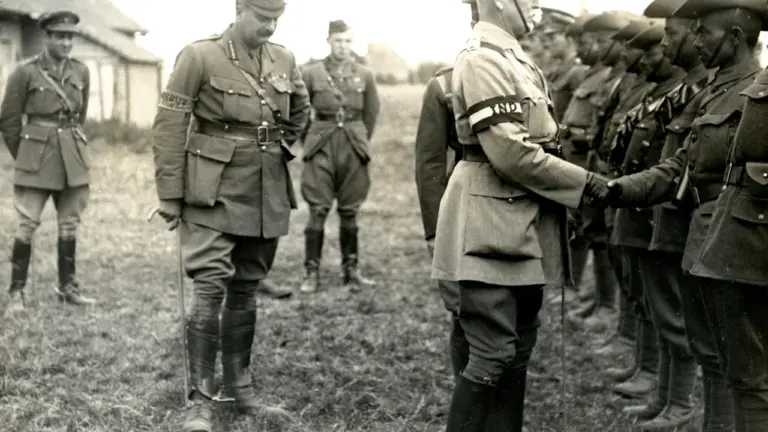
The anniversary carries a particular responsibility to remember those sometimes described as the “forgotten army.” British, Indian, African, Australian and other Allied forces had fought across Burma and the wider region. Prisoners of war and civilian internees endured forced labour, hunger, disease and abuse in Japanese captivity.
VJ Day also opens a broader historical conversation. Victory did not restore the pre-war world. Britain emerged economically weakened, independence movements had gained strength, and the legitimacy of European colonial control faced increasingly determined opposition. The end of one conflict therefore accelerated political changes that would reshape Britain’s global position.
Modern commemorations increasingly recognise that the war against Japan was multinational. That wider view challenges a narrowly domestic story of 1945 and gives greater visibility to the Commonwealth and colonial forces whose service was essential to the Allied campaign.
1947: Indian independence transformed Britain’s global role
Exactly two years after VJ Day, 15 August 1947 marked the end of British rule in India. Jawaharlal Nehru became independent India’s first prime minister, while the partition of British India created the new dominions of India and Pakistan. Pakistan observes its independence on 14 August, although the legislation establishing both dominions took legal effect on 15 August.
Independence was a landmark achievement after a long anti-colonial struggle. It was also accompanied by immense suffering. Partition divided Punjab and Bengal, prompting one of the largest migrations of the 20th century. Millions crossed newly established borders, while communal violence displaced families and destroyed communities.
For Britain, the transfer of power exposed the rapid decline of an imperial system that had once been presented as permanent. The Labour government led by Clement Attlee accepted that British control could not continue, but the speed and management of partition remain heavily debated.
The consequences are visible in modern Britain. Migration from India, Pakistan and later Bangladesh helped shape British cities, workplaces, food, music, literature and political life. Family histories connect many UK residents directly to independence and partition, while disputes over imperial monuments, museum collections and school curricula show that decolonisation is not a closed subject.

Remembering independence solely as a British withdrawal would miss both Indian political agency and the human consequences of partition. Its anniversary asks Britain to consider not only how empire ended, but also how imperial relationships continue to influence citizenship, identity and foreign policy.
1998: The Omagh bombing tested Northern Ireland’s peace
On 15 August 1998, a car bomb exploded in the County Tyrone town of Omagh. The attack killed 29 people, including a woman pregnant with twins, and injured hundreds. The dissident republican group known as the Real IRA claimed responsibility.
The bombing came four months after the Good Friday Agreement had offered a democratic framework for ending decades of conflict. Its timing created fear that opponents of the settlement could derail the peace process just as voters in Northern Ireland and the Republic of Ireland had endorsed it.
Omagh did not destroy that process, but its effects never disappeared. Survivors and bereaved families have spent decades seeking answers and accountability. The attack remains central to discussions about intelligence, policing, victims’ rights and the difficulty of obtaining justice for crimes committed around the end of the Troubles.
The anniversary also demonstrates that a peace agreement is a beginning rather than a final resolution. Political institutions can be established through negotiation, but public confidence depends on sustained cooperation, respect for victims and a willingness to confront contested memories.
Why these milestones remain part of modern British debate
These four events belong to separate centuries, yet each raises a recognisably modern question. Macbeth’s story asks who controls the public memory of a ruler. VJ Day tests how Britain recognises service beyond Europe. Indian independence requires an honest examination of empire and migration. Omagh shows why peace must be protected after an agreement is signed.
They also caution against treating “British history” as a story confined to Westminster or England. Scotland’s medieval monarchy, Asian and Commonwealth wartime service, South Asian independence and Northern Ireland’s peace process all belong within the history of the state and the people who live in it today.
Historic UK’s date-based history material identifies August 15 as a point of departure for exploring such anniversaries. Dates provide useful anchors, but their meaning comes from the developments before and after them. Macbeth’s death did not create modern Scotland in a day; VJ Day did not immediately settle the post-war order; Indian independence cannot be separated from partition; and Omagh cannot be understood without both the Troubles and the peace process.
The most useful next step on each anniversary is therefore to look beyond the headline date: at medieval records rather than Shakespeare alone, at the testimony of Far East veterans, at South Asian accounts of independence and partition, and at the continuing experiences of Omagh’s families and survivors.
Source: Historic UK
Context & actions About this article
Source check Historical context
This feature places selected August 15 anniversaries within their wider historical and modern British context.
- Dates and anniversary context were checked against Historic UK’s historical calendar.
- Distinct announcement, legal and formal surrender dates are identified where relevant.
- The account distinguishes Shakespeare’s Macbeth from the historical Scottish king.
- Sensitive descriptions of Omagh focus on established facts and the experiences of victims.
- Source
- Historic UK
- Scope
- United Kingdom
- Updated
- 2026-08-15 13:37
Source check
Report a trust issue
Send a clear signal to community moderation if the source, facts or context need review.

Comments