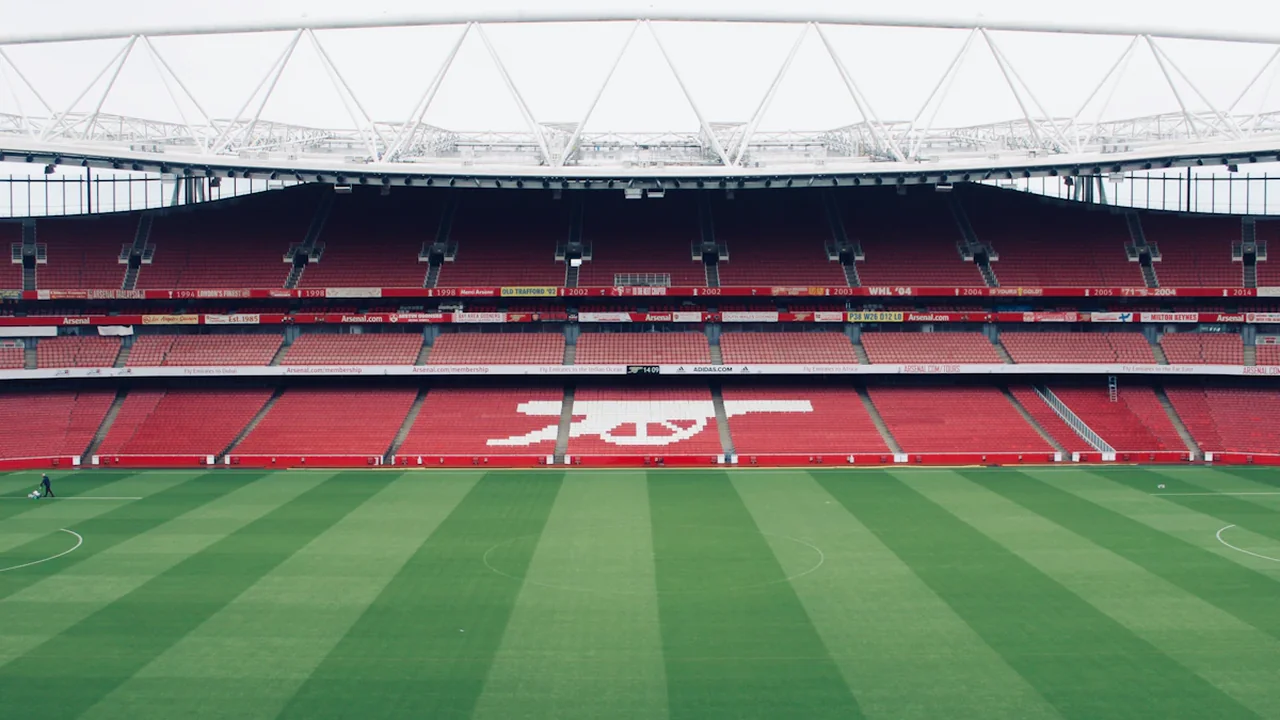
Arsenal and Manchester City will be separated by their positions in the final official 2026–27 Premier League table, not by reputation, expectations or an isolated run of results. The Premier League’s published table is the deciding record, while 23 May 2027 is the scheduled decision point readers should work toward when assessing the race.
By AtheneNet Sports Desk | 22 August 2026
The Arsenal-Manchester City forecast in one glance
- Question: Will Arsenal finish above Manchester City in the 2026–27 Premier League?
- Decision date: 23 May 2027, subject to the official season schedule.
- YES: Arsenal occupy the higher position in the final official table.
- NO: Manchester City occupy the higher position in the final official table.
- Deciding record: The Premier League table.
- Adjustment cutoff: A disciplinary change counts only if reflected officially by 30 June 2027.
The comparison should begin with five live fields for each club: position, matches played, points, goal difference and the next three league fixtures. Because those figures change after matches and fixture amendments, the current values should be read directly from the official table and Premier League fixture list, rather than copied without a reliable timestamp.
That caution is important early in a season. A team can sit higher because it has played an extra match, faced a different level of opposition or completed more home fixtures. Position alone becomes more informative when the clubs have played the same number of games and their schedules are reasonably comparable.
Points, games played and goal difference form the first test
The clearest starting point is the points gap. If Arsenal lead Manchester City while both have played the same number of matches, Arsenal hold the direct advantage. If one club has a game in hand, the raw gap needs context because the unplayed fixture may change both points and goal difference.
A fair comparison accounts for games in hand
Points per match can help when the clubs have played different totals, but it is not the resolution measure. The market is decided by the final table, where both teams should normally complete the same 38-match league programme.
Goal difference is the next useful indicator. It shows whether a points advantage is supported by a broader scoring margin, and it can become decisive if the clubs finish level on points. Goals scored and any subsequent official tie-breaking criteria matter only in the order applied by the Premier League.
Useful measurable checks include:
- Points and points per match over the full season to date.
- Goal difference and goals scored, not victories alone.
- Home and away performance across comparable fixture counts.
- Results against the same opponents.
- Points recovered from losing positions and points dropped from winning positions.
- The number and difficulty of remaining league matches.
No single indicator guarantees the final order. A strong goal difference can accompany a points deficit, while a narrow lead can disappear through one defeat and one rival victory.
The next three league fixtures can shift the comparison quickly
The next three league matches for each club should be taken from the official Premier League schedule. Arsenal’s official fixture page and Manchester City’s official fixture page are also important because they publish club schedules and confirmed fixture changes.
Three types of match deserve particular attention. The first is a direct Arsenal-Manchester City meeting, which can create a six-point relative swing: three points gained by one club and three unavailable to the other. The second is a difficult away match, where home advantage and travel add pressure. The third is a league fixture placed close to another confirmed competition commitment.
A short sequence should still be judged as part of the full schedule. Three favourable opponents do not establish a season-long advantage if a harder block follows, just as one difficult month does not decide the race when many fixtures remain.
Postponements also matter. A game in hand may look like an opportunity, but the rearranged match can produce a crowded later calendar. Until a new date is officially announced, assumptions about where that fixture will fit should not be treated as fact.
Confirmed congestion matters more than assumed workload
Schedule congestion becomes relevant when official fixture pages show short recovery periods between competitive matches. The useful comparison is not simply the number of competitions associated with each club, but the number of confirmed matches, travel demands and rest days in a defined period.
Look for concentrated runs, not a season-wide label
A practical congestion check should identify stretches containing three or more matches in roughly a week, repeated away trips or a major league fixture immediately following another competition. These periods may influence rotation and preparation, but they do not automatically produce dropped points.
Cup and European schedules can change through progression, elimination, television selections and postponements. Only confirmed dates should be included. Speculation about future rounds can illustrate possible pressure, but it should remain separate from the established calendar.
The most revealing test will be how each club performs during comparable congested blocks. League points collected, goals conceded late in matches and the use of available squad depth offer more evidence than a general claim that one schedule is harder.
Squad availability must come from named club information
Injuries and suspensions can alter the forecast, especially when several absences affect the same position. However, unverified reports, social-media claims and unsupported return dates should not drive a season-long conclusion.
Confirmed club updates, manager media briefings and official competition suspension information are the appropriate evidence. The relevant questions are whether an absence is confirmed, how many league matches it is expected to affect and whether the club has established alternatives in that role.
Availability should also be assessed collectively. One missing player may be manageable; several simultaneous absences among defenders, midfielders or attackers can have a larger tactical effect. Even then, the response on the pitch matters more than the headline around the absence.
Transfer speculation should remain outside the forecast until a club officially completes and announces a move. Rumoured arrivals or departures cannot be counted as squad strength.
What produces a YES or NO result
A YES outcome requires Arsenal to occupy a higher position than Manchester City in the official final table. The clearest Arsenal path is sustained points collection across home and away fixtures, a favourable return from the direct meetings and enough squad availability to navigate congested periods.
Arsenal would not need to win the title for the answer to be YES. They only need to finish higher than Manchester City, even if another club finishes above both.
A NO outcome requires Manchester City to finish higher. That path could involve City establishing a points advantage, overturning an Arsenal lead during the run-in or prevailing through the Premier League’s official ranking rules if the clubs finish level on points.
Manchester City also do not need to become champions for the answer to be NO. The comparison concerns the relative order of these two clubs, not whether either finishes first.
The forecast should remain open when the evidence is mixed. A small early points gap, uneven matches played or sharply different opponent quality is not enough for a confident season-long conclusion.
The official final table settles every close scenario
The scheduled final decision point is 23 May 2027. Once the league programme is complete, the higher published position determines the result.
If Arsenal and Manchester City finish level on points, the Premier League’s official tie-breaking rules apply. The published positions—not an independently calculated ranking—settle the comparison. That avoids ambiguity over goal difference, goals scored or any later tie-break stage.
A later disciplinary adjustment counts only if the Premier League incorporates it into the official final table by 30 June 2027. An appeal, investigation or report that has not changed the official table by that cutoff does not alter the result.
Abandoned matches, postponed fixtures or schedule changes do not create a separate test. The relevant evidence remains the completed season and the official ranking produced by the league.
The matches and indicators most likely to change the forecast
The direct league meetings carry the greatest immediate leverage, but the surrounding fixtures may reveal more about durability. Watch for runs in which one club faces several leading opponents, multiple away games or limited recovery time while the other has a less compressed programme.
The forecast becomes stronger when several signals agree: a meaningful points advantage, equal matches played, a superior goal difference and no major imbalance in remaining difficulty. It should weaken when the leader has played more matches, benefited from a much easier completed schedule or faces a denser confirmed run.
The next useful check is the official table after a substantial matchweek, followed by each club’s next three confirmed league fixtures. Together, those records show whether the current order reflects a durable advantage or merely the timing of the schedule.
Source: Premier League
Context & actions About this article
Source check How the forecast is decided
The result follows Arsenal and Manchester City’s positions in the official final Premier League table, including qualifying adjustments published by 30 June 2027.
- Compare position, matches played, points and goal difference in the official table.
- Use confirmed league dates from the Premier League and club fixture pages.
- Apply the Premier League’s published tie-breaking order if points are level.
- Count a disciplinary adjustment only if it changes the official table by 30 June 2027.
- Source
- Premier League table
- Scope
- England
- Updated
- 2026-08-22 12:56
Source check
Report a trust issue
Send a clear signal to community moderation if the source, facts or context need review.




Comments